
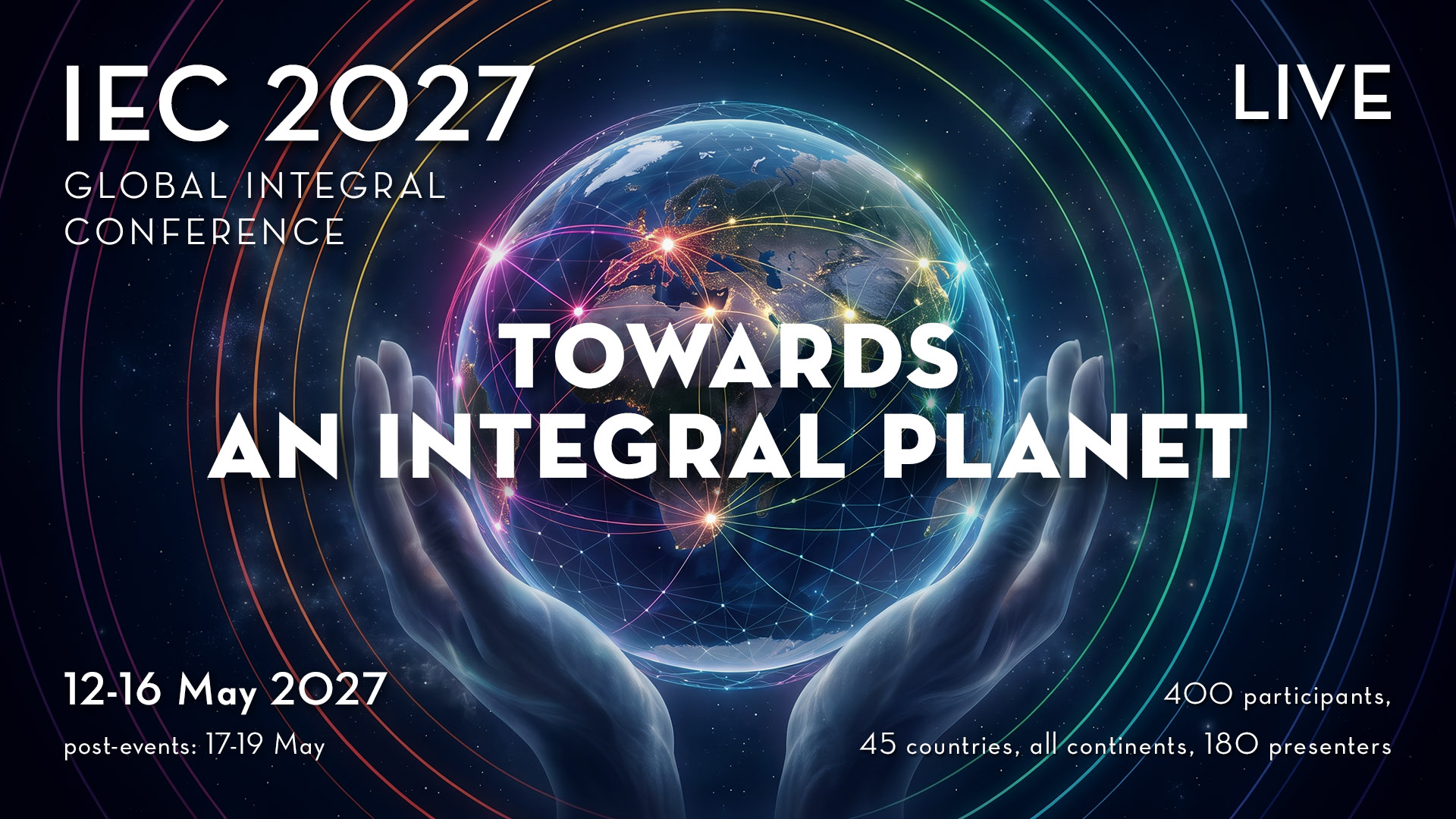
TOWARDS AN INTEGRAL PLANET
Integral European Conference 2027 | May 12–16 | Siófok, Hungary
What Will It Take to Move Towards an Integral Planet?
As we many know Integral Theory offers a unique approach to understanding human development and transformation by integrating the major models of Western psychology with the wisdom of the world’s great spiritual traditions into a comprehensive framework. Applied to psychology, coaching, organizational development, politics, business, education, spirituality, and more, it provides a powerful foundation for addressing the complex challenges of our time. But what would it mean to apply this integral vision not only to ourselves and our organizations, but to the future of our entire planet? What will it take to move towards an Integral Planet? This is the central question of IEC 2027.
An Integral Planet needs integral people who understand developmental stages and the spiral of evolution, and create synergy across them, serving Atman’s project: evolution itself. Knowing stages, quadrants, and lines — a brief history of everything — is only half the job. Neither love alone (the postmodern green dream) nor brilliant intellect trapped in its own head (the integral shadow) is enough. We need a centauric personality: the marriage of sense and soul, combining higher perspective-taking with a vast, open heart cultivated through inner work. Perhaps this is the religion of tomorrow for spiritual but not religious people — offering radical wholeness.
A World in Crisis is A World in Transformation
What if nature is a mirror of us?
The year 2026 has confronted humanity with extraordinary ecological and political challenges. The year of 2026 marked by extreme natural events, perhaps at higher intensity and density than ever before. Extreme heatwaves (heatdomes) hit Europe, and the Middle-East, Japan and Souht-Korea. The Danube, Europe’s second-longest river, dropped to exceptionally low water levels, raising fears of a national crisis in IEC host country Hungary, and also Romania, threatening operations at nuclear power plants. We have witnessed unusual wildfires across Europe, like France, Spain, Croatia and also in Canada. In the USA in most states also had the hottest summers. In Europe and Africa, extreem droughts appeared, and unbalanced weather patterns hit Australia. Calima got out of controll in the Canary Islands, while powerful earthquakes struck Colombia, Venezuela, Panama, Mexico as well as Southeast Asia and Japan. In an unprecedented announcement, the World Meteorological Organization (WMO) expressed nearly 100% certainty that the exceptionally strong El Niño would persist into 2027, warning that it could become the most powerful event ever recorded.
From ego-and etnocentric regimes to renewed world-centric democracies
Politically we have witnessed the rise of right-wing and far-right movements, and authoritarian leaders increasing polarization. This includes the terrible war of Russia on Ukraine, the devastating war in Gaza, the US war on Iran with its crippling effects, and the aggressive right-wing leaders of Latin America, such as Milei in Argentina, de la Espriella in Colombia, who trample on social welfare, disregard Indigenous rights, and hand sell ecologically protected and Indigenous territories to foreign corporates. The unprecedented rise of the far-right Alternative for Germany (AfD) in 2026, reflecting the broader resurgence of right-wing nationalism across Europe, fueled in part by Europe’s growing tensions over immigration, integration, and cultural identity.
Yet we have also seen signs of hope, including Hungary’s historic democratic transformation after sixteen years of Orbán’s rule in May 2026, electing a new democratic government of Magyar, that brings back healthy amber, orange and green politics. A similarly powerful shift seems to happen also in Serbia.
Are we witnessing merely a series of disconnected ecological and political crises, or are these events expressions of a larger transformation in human consciousness and civilization?
Beyond Growing Up and Waking Up — Reconnecting with the Earth
Within integral circles, we have developed considerable expertise in Western developmental psychology and Eastern contemplative traditions, focusing mainly on personal development — Growing Up — and spiritual awakening — Waking Up— supported by the indispensable — Cleaning up— and — necessary Showing up.
Earthing Up (or waking down): perhaps the time has come to complement these with another essential dimension, restoring our harmonious relationship with the Earth?
We may need not only modern scientific and technological approaches to ecology, but also the wisdom of peoples who have maintained a close relationship with nature for thousands of years. What can we learn from cultures that understand the Earth not merely as a collection of resources, but as a living reality with which humanity participates in a sacred relationship?
In 2027: Indigenous Wisdom Meets Integral Theory
This is why IEC 2027 will welcome special guests from one of the world’s most ancient surviving Indigenous cultures: the Kogi people of Colombia’s Sierra Nevada de Santa Marta. Perhaps it is time to recognize that Indigenous wisdom is not merely something to learn from others, but something to reawaken within ourselves? After 4,000 years of relative isolation, the Kogi people of Colombia stepped forward to warn their “Younger Brothers” — the rest of humanity — about the devastating ecological consequences of our actions and offer their help. Their message reached the world through the famous BBC documentary Aluna, which received international attention in connection with the 2012 Rio Earth Summit. Now, the Kogi are coming to IEC 2027 personally, to share their ancient wisdom and urgent message with the global integral community! Their presence will create a unique opportunity for an encounter between indigenous spirituality and contemporary Integral Theory and practice.
Beyond CO₂
What if there is indeed a deeper connection between humanity’s inner state and nature, beyond CO₂ emissions— one that is not merely some New Age, “purple” nonsense, but a profound reality that we need the learn from the indigenous, to have a fuller integral approach?
Towards a More Integral Understanding of Indigenous Spirituality
Within integral circles, Indigenous traditions are sometimes dismissed as pre-rational or interpreted primarily through developmental models that emphasize their limitations, because they are „early stages”. Yet could these traditions – especially their mamos and sakas (male and female shamans) – also preserve genuine psychic and subtle capacities, sophisticated ecological knowledge, and dimensions of spiritual realization that both modern Western culture and both Eastern contemplative traditions havelargely overlooked?
A truly integral approach calls us to move beyond both spiritually romanticizing Indigenous cultures and dismissing them, and explore better. This dialogue may expand our understanding of what an integral approach to spirituality and planetary life can truly mean.
No One Has the Whole Answer: We Have It Together
No single person, and tradition holds the complete answer to humanity’s challenges. Not science alone, not spirituality alone, not politics, psychology, meditation, technology, or Indigenous wisdom alone . We need an all stages and four quadrant approach and to discover the answers together through a collective, creative process. We believe the global integral community has an important role to play in this transformation. Yet creating an Integral Planet requires cooperation far beyond our own community, while never losing sight of the extraordinary value of our integral approach and community itself.
A Living Global Integral Community
For more than a decade, IEC and other integral conferences in the movement has brought together integral thinkers, practitioners, and explorers from dozens of countries, creating friendships, collaborations, and a profound sense of belonging. Whether you work in therapy, coaching, group facilitation, organizational leadership, science, politics, business, education, art, or spirituality — whether you are an experienced integral expert or completely new to this world — this conference is for you. We warmly invite our integral brothers and sisters from North and South America, including the ICON community, as well as Africa, the Middle East, Asia, Australia, and across Europe. This is a truly global gathering where you may discover a community of like-minded people who feel like home.
Two reasons why not to come to IEC
As integral thinkers, it can be easy to become silently critical, believing we know how things could or should be done better at a conference or within an integral community. And while constructive criticism is valuable, it can sometimes become a reason for staying away rather than showing up and contributing — unintentionally weakening the very global integral community we wish to see thrive. Is this really what we want?
Let’s avoid the integral shadow of quietly assuming that our complex thinking makes us more integral than others, criticizing from the sidelines instead of actively participating. And let’s also recognize the opposite shadow: believing that we are not integral enough, not developed enough, or not really worthy of being there, or not knowing what to say. For some, even the fear of not speaking English well enough can be intimidating. Most of us are not native English speakers there. We are all a global community. Moving beyond these inner barriers helps to come.
Neither subliminal superiority nor crippling inferiority should keep us apart. We need each other, exactly as we are.
Your presence is your vote! – for the integral community
Your physical presence is your vote — a vote for the very existence of a living global integral community. It is not enough to wish for such a community from afar, simply “sending good wishes,” or to take the existence of the global integral community and its conferences for granted, as if they were simply always there. They do not exist by themselves. We must continually make the effort, overcome obstacles, and commit to coming together to keep this community alive.
Therefore, we invite you to make the effort, embrace the sacrifices involved, and take this journey — just as we, the organizers, are making that commitment for all of us, for the integral movement, and ultimately for the Earth!
Let your participation be an offering to the integral community, and to the world, right as you are.
From “What will I get?” to “What do I stand for”
Also don’t measure your participation merely in terms of personal, or career benefits. „What will I get”? „Does it worth the time and money to go, for promoting my work?” While these Orange questions are important, we invite you to come for Green, Teal, and Turquoise purposes as well — and even for the Magenta experience of belonging to a larger whole on this Planet: finding your international tribe, being among like-minded and like-hearted people, and feeling part of something greater than yourself. Instead, ask yourself: Do I believe the integral movement is something noble, valuable, and essential, something worth supporting from my heart? If so, let my presence say YES — that alone is reason enough to come. Career, networking, and marketing matter too, but they come second to supporting something greater than myself. If we don’t stand for the integral movement, what do we stand for? By showing up, we make the global integral community a living reality.
Without a global tribe there is no world-centric self
To become a later-stage world-centric self, a global self, you must step beyond your own country and cultural bubble, transcending even the ethnocentrism you may not recognize in yourself. Immerse yourself in the living global integral community, because real human encounters and shared experiences transform your felt sense of identity — not merely thinking about global issues among your fellow countrymen.
Together, let us move Towards an Integral Planet!
IEC 2027 | May 12–16 | Siófok, Hungary